


The real story this year is not that boards are behind — most aren’t, particularly. It’s that the market is being redrawn faster with increasingly asymmetric outcomes by businesses that aren’t waiting for anyone’s AI strategy to catch up.
In 60 seconds
1/ Only ~5% of companies show substantial financial gain from AI so far — but that 5% posts roughly four times the three-year shareholder return of everyone else. The prize is real, and concentrated.
2/ The sharper board question isn’t “what’s our AI strategy?” It’s “what would a well-funded AI-native rival do to our value chain first?”
3/ Three examples of how AI natives play: Cursor attacks your product. Harvey attacks how the work gets done. Sierra attacks how you make money.
4/ The Six Ps force the choices that actually matter: posture, profit pools, proprietary edge, platform, process, proof & permission.
5/ This week’s Library piece turns all of this into an actual dashboard — what to measure, and what good and bad look like on one page.
Why clarity of strategy & focused execution are the story, not adoption
BCG’s 2026 AI transformation work found that only around 5% of organisations have generated substantial financial gains from AI — though the few that have show roughly four times the three-year shareholder return of everyone else. McKinsey’s parallel measurement work makes the diagnosis sharper still: most companies cannot draw an auditable line from model performance to user adoption to operating KPIs to financial impact. Activity is high. Evidence is thin.
So the fashionable board question — “What is our AI strategy?” — turns out to be the wrong one. It invites a slide deck: pilots, copilots, a vendor logo wall, a training completion rate. None of that tells a board whether the business is safer or more valuable. The question that actually earns its place at committee is the ‘Founder Question’:
With £100 million, frontier models, no legacy systems and no sacred cows, where would we attack ourselves first?
The gap between “we adopted AI” and “we understand what AI does to our economics” is exactly where a challenger gets in.
What the smartest firms actually agree on
The leading strategy firms and business schools are finally coming to a simple truth - AI value is not captured by access to models. It is captured by redesigning the business around workflows, proprietary advantage and measurable economics. Everyone can rent the same frontier model. Nobody can rent your customer data, your distribution, or your regulatory licence. That is where the real argument sits — not in who has the best chatbot.
Three AI disruptors. Three warnings.
AI-native start-ups aren’t simply “using AI more” than incumbents — they’re built on a different premise: intelligence is infrastructure, not headcount. AWS’s 2026 research found 68% of AI-native start-ups have a comprehensive AI strategy versus 45% of start-ups generally, 72% have built proprietary AI capability versus 30%, and 98% employ dedicated AI talent versus 70% of large enterprises. A Harvard/INSEAD study reported by Business Insider found these firms run about 25% smaller, with 13% more engineers and far fewer entry-level staff and managers than their non-AI-native peers.
Three examples bring this to life:
Cursor – reinvent the product. Instead of adding AI to traditional coding software, Cursor rebuilt the developer experience around AI agents that can understand, write and modify software. The result: reported recurring revenue reached $2bn by March 2026, while 64% of the Fortune 500 now use it. Lesson: don’t bolt AI onto yesterday’s product. Ask: if we started again today, would we build our core product the same way—or could an AI-native startup make it obsolete?
Harvey – reinvent the workflow. Harvey applies AI deeply to legal work—researching, drafting, reviewing contracts and executing complex workflows that once consumed hours of expensive professional time. It now serves 142,000+ lawyers across 1,500+ organisations, including 60%+ of the AmLaw 100, and was valued at $11bn in March 2026. Lesson: don’t scatter AI across 100 productivity pilots. Find the few high-value workflows where AI can collapse hours into minutes—and build a defensible advantage around your data, expertise and customers before someone else does.
Sierra – reinvent the economics. Sierra’s AI agents don’t just answer customer questions; they can take actions and resolve problems, with pricing increasingly tied to outcomes rather than software seats or human hours. It passed $100m ARR just seven quarters after launch and was valued at over $15bn by May 2026. Lesson: AI may not merely reduce your costs—it can destroy the basis on which you charge. Ask: what happens if a competitor delivers our customer’s outcome at a fraction of our price?
Corporates can reinvent themselves too
John Deere and Caterpillar show that century-old industrial companies can become technology businesses without abandoning their core. Deere has moved from selling tractors to combining machines with GPS, computer vision, AI, autonomy and a digital Operations Center—turning farming into a data-driven system and creating software and recurring-revenue opportunities around the machine. Caterpillar has built an ecosystem of 1.6m+ connected assets, using their data, analytics and AI for predictive maintenance, productivity and autonomous equipment. Lesson: incumbents can transform—but only when technology becomes core to the product, customer value and business model, not an IT initiative bolted onto the side.
Put the Founder question on your board table every 6 months : With £100 million, frontier models, no legacy systems and no sacred cows, where would we attack ourselves first?
Incumbents ask, “how do we add AI to our business?” AI-native challengers ask, “what business becomes possible once coordination, analysis and customer interaction are radically cheaper?”
The uncomfortable truth: startups have no legacy revenue to defend. They can reinvent your product, workflow and profit pool while you are still debating how much of today’s business you are prepared to cannibalise.
The Six Ps of an AI strategy: a board framework, not a CIO one
How do you systematically make connected proactive choices from where you are to where you want to be - with clarity regarding competitive advantage (cost or differentiation), how to get there & how to measure the outcome. Welcome to the 6 P’s framework - a simple framework akin to what the leading strategy houses and business schools are selling:
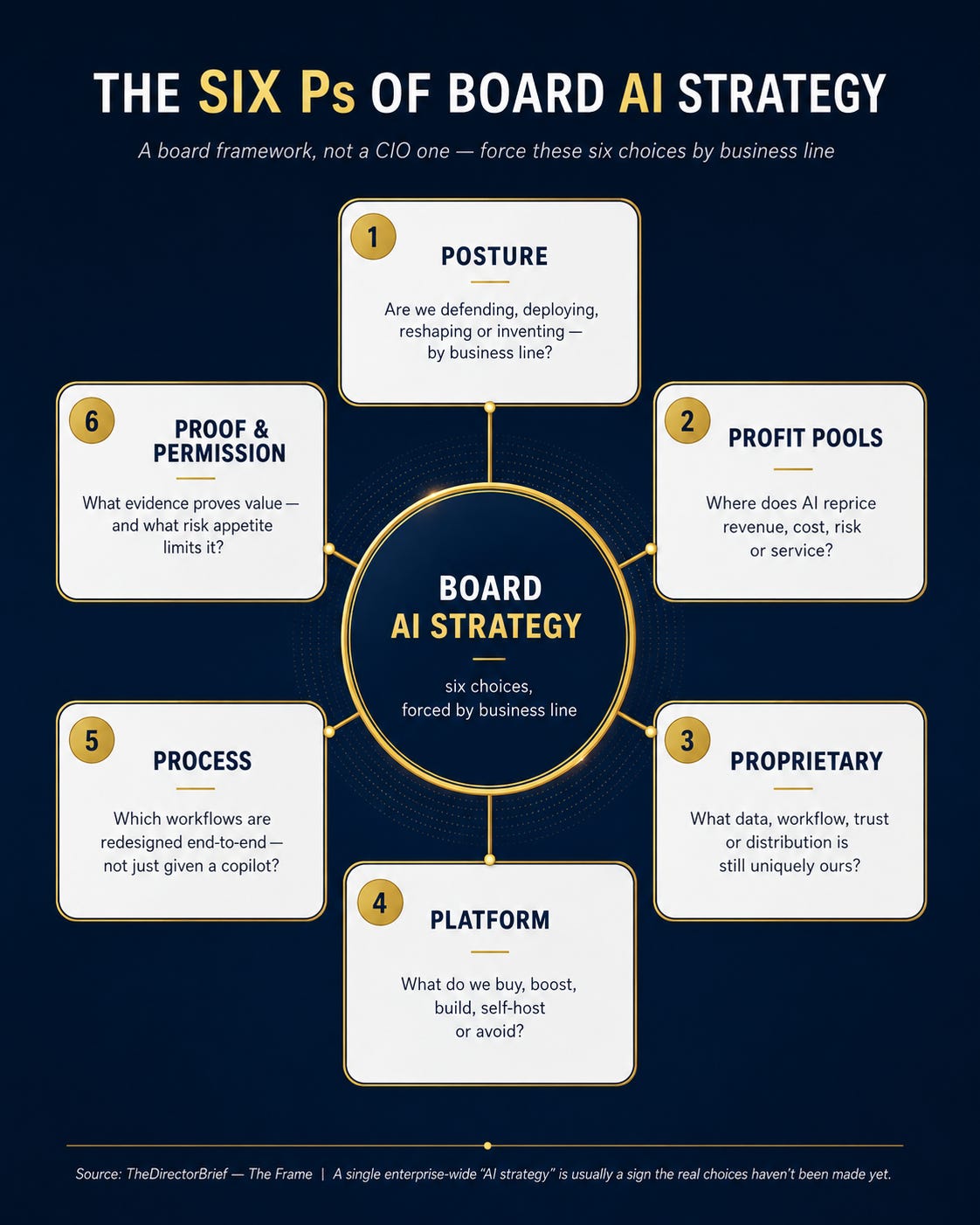
Posture. By business line: are we defending the core, deploying AI inside the current model, reshaping the operating model around it, inventing something new — or deliberately waiting? Vague answers here mean nothing downstream will be sharp either.
Profit pools. AI doesn’t hit “the company” evenly. One way to look at this is from the frame of how an agentic start up might attack your business? As per the examples of Cursor, Harvey and Sierra discussed above.
Proprietary advantage. Most companies have no AI moat — they have a rental agreement with the same model everyone else uses. Durable advantage comes from what can’t be rented: proprietary data, embedded workflow, trust, brand, distribution, regulatory position. The board question is simple — what’s still ours once everyone has the same model?
Platform. Buy, boost, build, self-host or avoid — by use case, not by enterprise-wide edict. Buying is fast and undifferentiated. Building is powerful and expensive. Most companies will end up hybrid: frontier models for hard reasoning, cheap models for routine work, tight controls where a regulator is watching.
Process. This is where strategy either becomes real or quietly dies. AI bolted onto a bad process just produces faster bureaucracy. The board shouldn’t accept “we have 40 use cases” as evidence of anything. Ask instead which five workflows have been redesigned end-to-end, who owns each one, and what the before-and-after economics actually are.
Proof & permission. Proof means value is measured, not asserted. Permission means the risk appetite is explicit — where AI can act alone, where it must stay a copilot, where it’s banned outright. As agentic systems move from answering questions to taking actions, this stops being a technology question and becomes a board risk-appetite question.
The cost curve nobody’s watching
There’s a second reason “proof & permission” earns its place as a standalone P: AI is not simply getting cheaper. Commodity-tier models are in genuine price freefall — a routine task now costs a fraction of what it did eighteen months ago. But the frontier, agentic layer is moving the opposite way. Run the current published output-token prices in order and the ceiling has roughly quintupled since the cheapest commodity model, before you even count the volume: agentic coding tasks have been measured consuming up to 1,000 times more tokens than a simple reasoning query, with up to 30x variance between two runs of the same task and no guarantee the extra spend buys extra accuracy. “AI gets cheaper” is the headline. “AI is deflating at the commodity layer and inflating at the frontier layer” is the board-relevant sentence — and it’s why unit economics per workflow, not per licence, belongs on the dashboard.
What to ask at your next board meeting (& how to measure progress)?
Ten sharp questions for your next board meeting, below — and a worked example of what an actual AI strategy dashboard looks like, in this week’s Library piece. Between them, “how many copilots have we deployed?” stops being an acceptable answer to anything, and the only question that matters takes its place: where will AI change the economics of our business before the market does it for us?
FIVE FOR THE CHAIR · EXTENDED
Ten Questions for Your Next Board Meeting
1. What would an AI-native attacker do to our most profitable workflow first — and why have we not done it ourselves?
2. Which three profit pools are most exposed to AI-driven repricing of cost, service, risk or customer access? Where would an agentic start up attack us first?
3. What is our AI posture by business line: defend, deploy, reshape, invent or wait?
4. Which AI initiatives are table stakes, and which could create proprietary advantage?
5. What proprietary data, workflow, distribution, trust or regulatory position are we using to create a moat?
6. Which workflows have been redesigned end-to-end — not just given copilots?
7. What do we buy, boost, build, self-host or deliberately avoid — and why?
8. What is the full AI unit economics by use case, including token, cloud, vendor, integration, compliance and change costs?
9. Where can AI act autonomously, where must it remain human-in-the-loop, and where is it prohibited?
10. Which AI projects have we killed, and what did we learn from them?
Every week in TheDirectorBrief.
## 🎯 The Frame — one topical AI conversation relevant to Boards. Designed to encourage debate and action. Covering 4 domaines: Strategy & innovation; risk & resilience; governance & accountability; capability & culture.
## ❓Five for the Chair — five board-ready questions anchored in this week’s Frame, screenshot-able into next Monday’s agenda. What should the board actually debate?
## 📡 The Signal — five Board relevant AI developments you need to know about this week. Plus the STAT and CHART of the week. What changed — and what should we do?
## 📚 The Library — “AI academy”: the manual: primers, tools, templates, checklists, plus the Monday-Morning build (one tool to test, one prompt that earns its place). Do we have the literacy to govern this?
One read. Thirty minutes. Before your next board deck
Subscribe free at TheDirectorBrief.com
To help me make this better please feel free to send me any comments, feedback or suggestions to hello@thedirectorsbrief.com. Thank you for reading.
Disclaimer: These are my personal views, shaped in a fast-moving environment and open to revision. They should not be taken as representing the perspectives of any boards or advisory roles, past or present.