


Many board packs that claim to cover “AI progress” are really activity reports: licences issued, workshops run, pilots launched. None of that tells a Board whether the business is safer, cheaper to run, or harder to attack. It tells you what management has been busy doing — not what’s actually changed.
The fix isn’t a longer report. It’s a different one page.
What follows is a worked example: not a template to fill in blindly, but a guide to what a genuine AI strategy dashboard should contain, and — just as importantly — what each line is actually testing for. It’s built around eight baskets that map onto the Four-Domain Frame this publication uses to keep board AI oversight honest — Strategy & Innovation, Risk & Resilience, Governance & Accountability, Capability & Culture — plus the one basket most dashboards miss entirely: portfolio discipline and value realisation.
Companion piece to “Somewhere, a Start-Up Is Already Pricing the Gap”
The figures are illustrative, built for a fictional composite board. Swap in your own and the exercise becomes real.
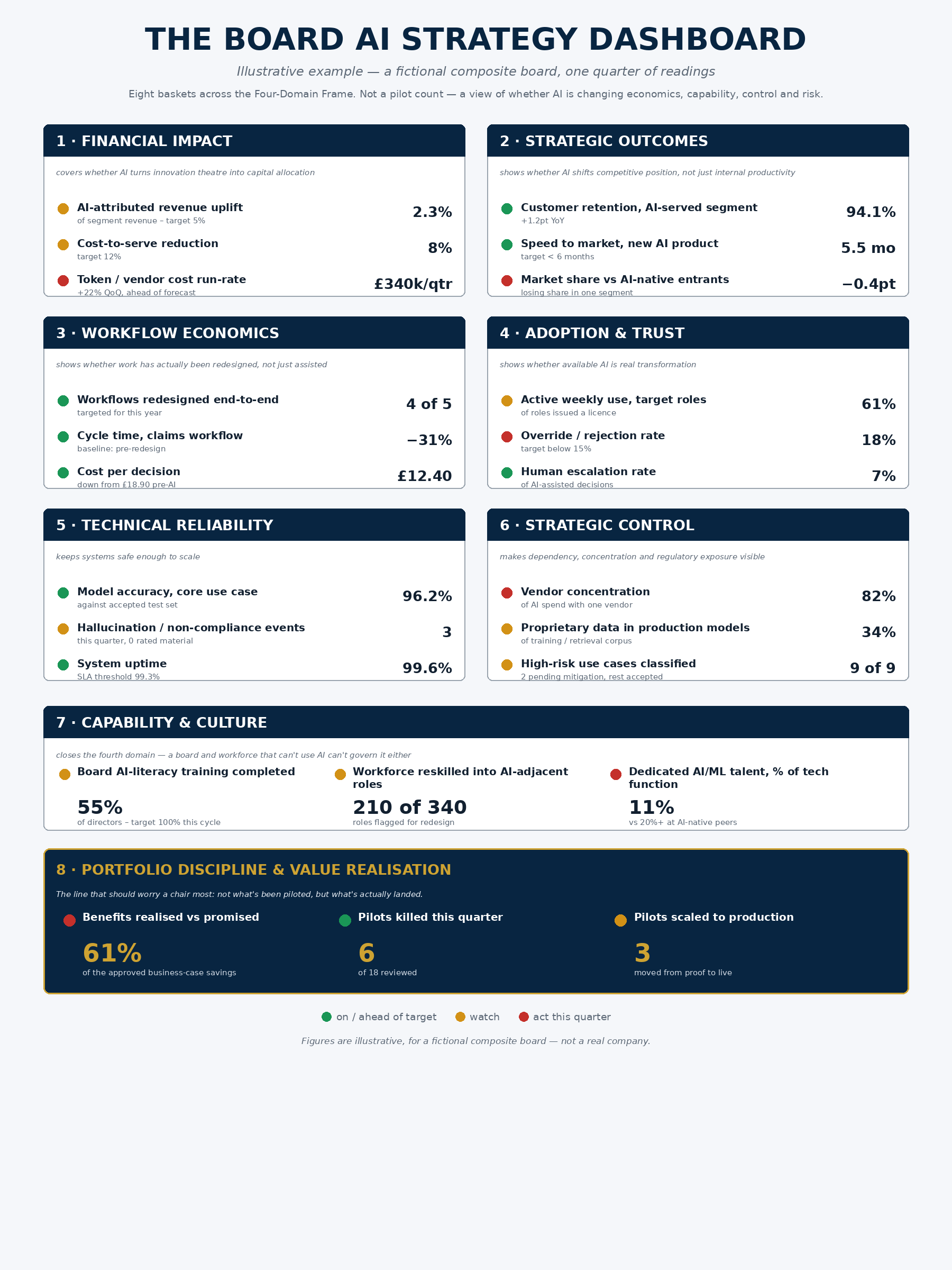
Reading it basket by basket
Financial impact and strategic outcomes (1–2) are the pair a CFO and a strategy committee should already recognise: revenue uplift, cost-to-serve, retention, speed to market. They convert AI from experiment into capital allocation, and from internal productivity theatre into a genuine competitive-position test.
Workflow economics and adoption & trust (3–4) are the reality check underneath. A workflow that’s been “redesigned” but shows no cycle-time or cost-per-decision movement hasn’t been redesigned — it’s been decorated. And AI that’s licensed but not used, or used but constantly overridden, isn’t transformation; it’s shelfware with a subscription fee.
Technical reliability and strategic control (5–6) are the two baskets a risk committee should own outright: is the system safe enough to keep scaling, and is the company dangerously dependent on one vendor, one model, or a pile of “high-risk” use cases still sitting outside the regulatory taxonomy.
Capability & culture (7) is the basket most AI dashboards skip completely — and the one this publication’s Four-Domain Frame won’t let us skip. A board and a workforce that can’t use AI competently can’t govern it competently either. That’s not an abstract governance point: it’s the same gap the Diligent Institute found at board level (82% of directors already using AI; just 6% with a policy) showing up one layer down, in the workforce whose output the board is ultimately accountable for. Track training completion, reskilling against roles actually flagged for redesign, and how thin the organisation’s own AI talent bench is against AI-native peers — because that gap is exactly what an AI-native rival is resourced not to have.
Which line actually matters most
The instinctive answer is basket 8’s first metric family: pilots killed. If nothing’s been stopped, nothing’s being actively managed — that’s a fair diagnostic, and it’s the one most commonly cited as the single most important line on an AI dashboard.
Sat in front of a real board, I’d push back on that instinct. Killed pilots tell you management is being disciplined about process. They don’t tell you whether the portfolio is actually working. The number that should worry a chair more sits right next to it: benefits realised versus promised. Sixty-one per cent means more than a third of the value the board approved capital for hasn’t shown up — and that gap is precisely what the BCG and McKinsey data in this week’s Frame piece warns about: high activity, thin evidence, most of the value concentrated in a small minority of companies that can prove it lands. Killed pilots explain the mechanism. Benefits realised is the verdict. Put the verdict first.
How to use this
Don’t copy the eight baskets wholesale — reweight them for your sector. A regulated financial-services board will lean harder on strategic control; a consumer business will lean harder on strategic outcomes and adoption.
Ask management to bring the red and amber lines to committee, not the green ones. A dashboard that’s all green is a dashboard nobody has stress-tested.
Revisit quarterly. The individual reading matters less than the trend — a portfolio-discipline number moving from 40% to 61% is a very different conversation to one stuck at 61% for a year.
If management can’t populate a line, that’s data too. A blank cell on “AI unit economics by use case” is more informative than a confident-looking pilot count.
Every week in TheDirectorBrief.
## 🎯 The Frame — one topical AI conversation relevant to Boards. Designed to encourage debate and action. Covering 4 domaines: Strategy & innovation; risk & resilience; governance & accountability; capability & culture.
## ❓Five for the Chair — five board-ready questions anchored in this week’s Frame, screenshot-able into next Monday’s agenda. What should the board actually debate?
## 📡 The Signal — five Board relevant AI developments you need to know about this week. Plus the STAT and CHART of the week. What changed — and what should we do?
## 📚 The Library — “AI academy”: the manual: primers, tools, templates, checklists, plus the Monday-Morning build (one tool to test, one prompt that earns its place). Do we have the literacy to govern this?
One read. Thirty minutes. Before your next board deck
Subscribe free at TheDirectorBrief.com
To help me make this better please feel free to send me any comments, feedback or suggestions to hello@thedirectorsbrief.com. Thank you for reading.
Disclaimer: These are my personal views, shaped in a fast-moving environment and open to revision. They should not be taken as representing the perspectives of any boards or advisory roles, past or present.