


The Director Brief: AI intelligence for Board Directors
Strategy, Risk, Governance, Capability
Issue #003. 17th July 2026
Only 5% of companies have turned AI into real financial gain. That 5% is posting 4x the shareholder return of everyone else — while Cursor (code), Sierra (customer service), Harvey (legal) and Glean (enterprise knowledge) quietly rebuilt other people’s workflows using agents into $150m–$2bn of ARR.
So the question this week isn’t “what’s our AI strategy?” It’s sharper: what would a well-funded AI-native rival do to your value chain first — and why haven’t you done it yourself?
Inside this issue:
## 🎯The Frame · the Six Ps — a board framework for AI strategy, not a CIO one — plus the cost curve nobody’s watching
## ❓ Five for the Chair · This week’s key questions. For your next board meeting, including the Founder question: With £100m and no sacred cows, where would we attack ourselves first?
## 📚The Library · The system. the one-page AI dashboard to lift straight into your next board pack — eight baskets, and the single line that should worry a chair most
Also in this week’s issue:
## 📡 The Signal · AI signal vs noise. What changed this week: The most consequential AI essay of the year. Firework AI - a company you need to know. Chinese open source powering away. The new AI interface battleground. The gap between pilot & production.
## 🛠 Monday Morning· The Director’s AI Build. Week two of a six week course for Board Directors. Free Director AI education programme….which puts the tools in your hands.
Read before your next board pack. AI intelligence for directors - strategy, risk, governance, capability
👉 Read this week’s issue on TheDirectorBrief
________________________________________________________________________
## 🎯 THE FRAME· the strategic conversation of the week
### Somewhere, a Start-Up Is Already Pricing the Gap in Your AI Strategy…….
The uncomfortable numbers:
Only ~5% of companies show substantial financial gain from AI (BCG, 2026) — but that 5% posts roughly 4x the three-year shareholder return of everyone else. The prize is real, and concentrated
Most companies cannot draw an auditable line from model performance to adoption to operating KPIs to financial impact (McKinsey). Activity is high. Evidence is thin
Meanwhile the attackers are already through the door: Cursor past $2bn ARR in software development, Sierra past $150m in customer service, Harvey past $190m in legal, Glean at $200m in enterprise knowledge. None attacked a whole industry. Each took one expensive workflow, end to end
These firms are built differently: 72% have proprietary AI capability vs 30% of start-ups generally (AWS, 2026); they run ~25% smaller with 13% more engineers (Harvard/INSEAD). Not a rival with a better chatbot — a rival with a structurally cheaper cost model
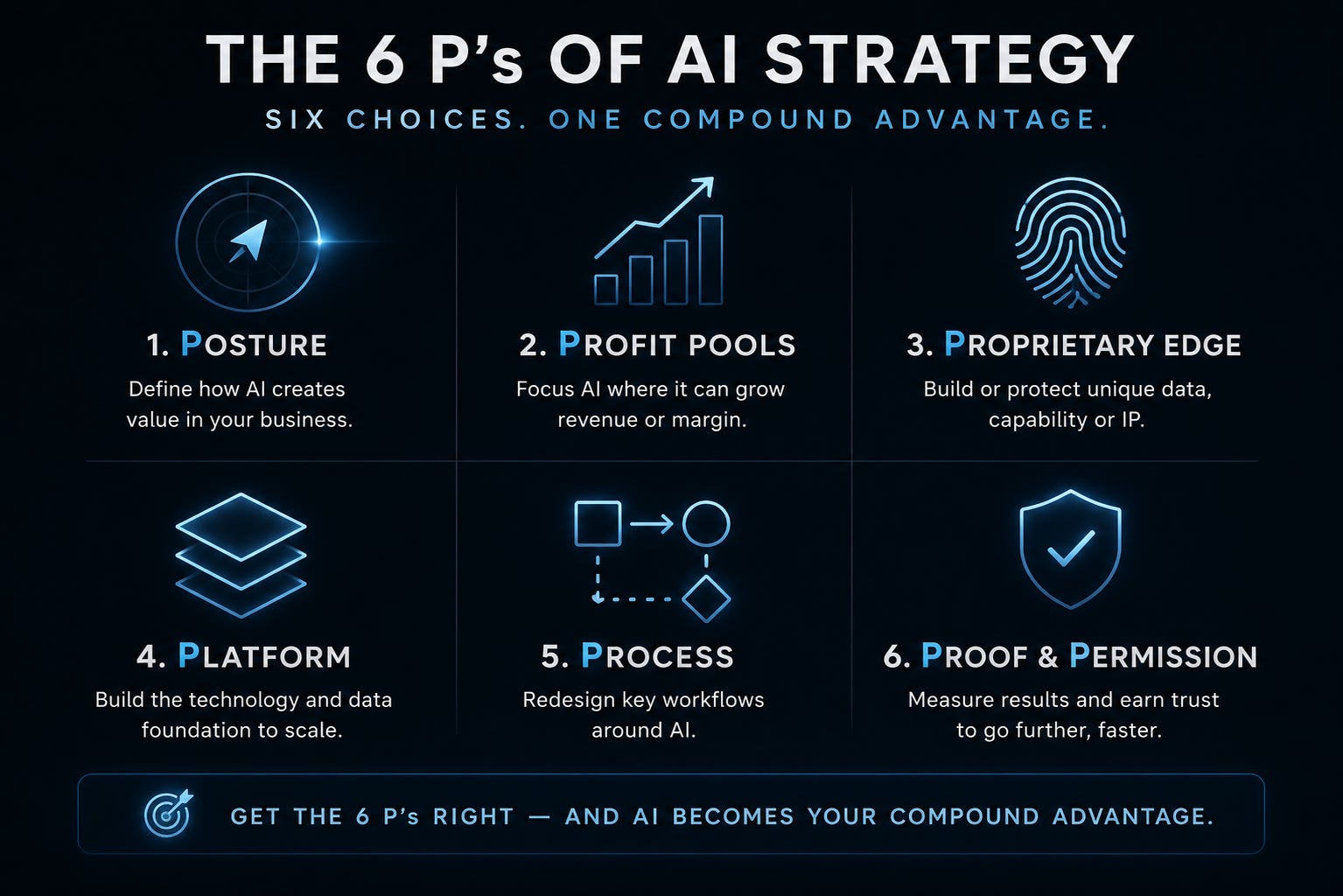
What the issue gives you — the Six Ps of an AI Strategy, a board framework, not a CIO one:
Posture. By business line: defend, deploy, reshape, invent — or deliberately wait
Profit pools. Where would an agentic start-up reprice your cost, service, risk or customer access first?
Proprietary advantage. Everyone rents the same frontier model. What’s still yours once they do — data, distribution, trust, regulatory position?
Platform. Buy, boost, build, self-host or avoid — by use case, not edict
Process. “40 use cases” is evidence of nothing. Which five workflows are redesigned end to end, and what are the before-and-after economics?
Proof & permission. Value measured, not asserted — and explicit appetite for where AI acts alone, assists, or is banned
Plus the cost curve nobody’s watching: commodity AI is in price freefall while the frontier layer inflates — agentic tasks consuming up to 1,000x the tokens of a simple query, with 30x variance between identical runs. Unit economics per workflow, not per licence, is the board number.
Walk away with: ten questions for your next board agenda — including the clean-sheet test: with £100m, frontier models and no sacred cows, where would we attack ourselves first?
## ❓ FIVE FOR THE CHAIR
The 5 key questions to help you challenge your ‘AI strategy’
1. What would an AI-native attacker do to our most profitable workflow first — and why have we not done it ourselves?
2. What is our AI posture by business line: defend, deploy, reshape, invent or wait?
3. What proprietary data, workflow, distribution, trust or regulatory position are we using to create a moat?
4. What do we buy, boost, build, self-host or deliberately avoid — and why?
5. What is the full AI unit economics by use case, including token, cloud, vendor, integration, compliance and change costs?
## 📡 SIGNAL· AI signal vs noise
[1] Stat of the week: $300m to $1bn ARR in seven months - Fireworks AI just closed a $1.5bn round (a company every corporate needs to know)
Fireworks AI runs, fine-tunes and serves open-source models (Llama, DeepSeek, Qwen and others) at low latency, letting companies train their own specialized model on their own proprietary data instead of just calling a frontier API. The paradigm shift: over 95% of Fireworks’ 40 trillion daily tokens now come from these customer-specialized models, not generic ones — Cursor, Notion, Uber, DoorDash and Harvey are all “owning” intelligence rather than renting it. That inverts the assumption most corporates still operate on, that AI strategy means picking a frontier vendor (OpenAI, Anthropic, Google) and paying per token.
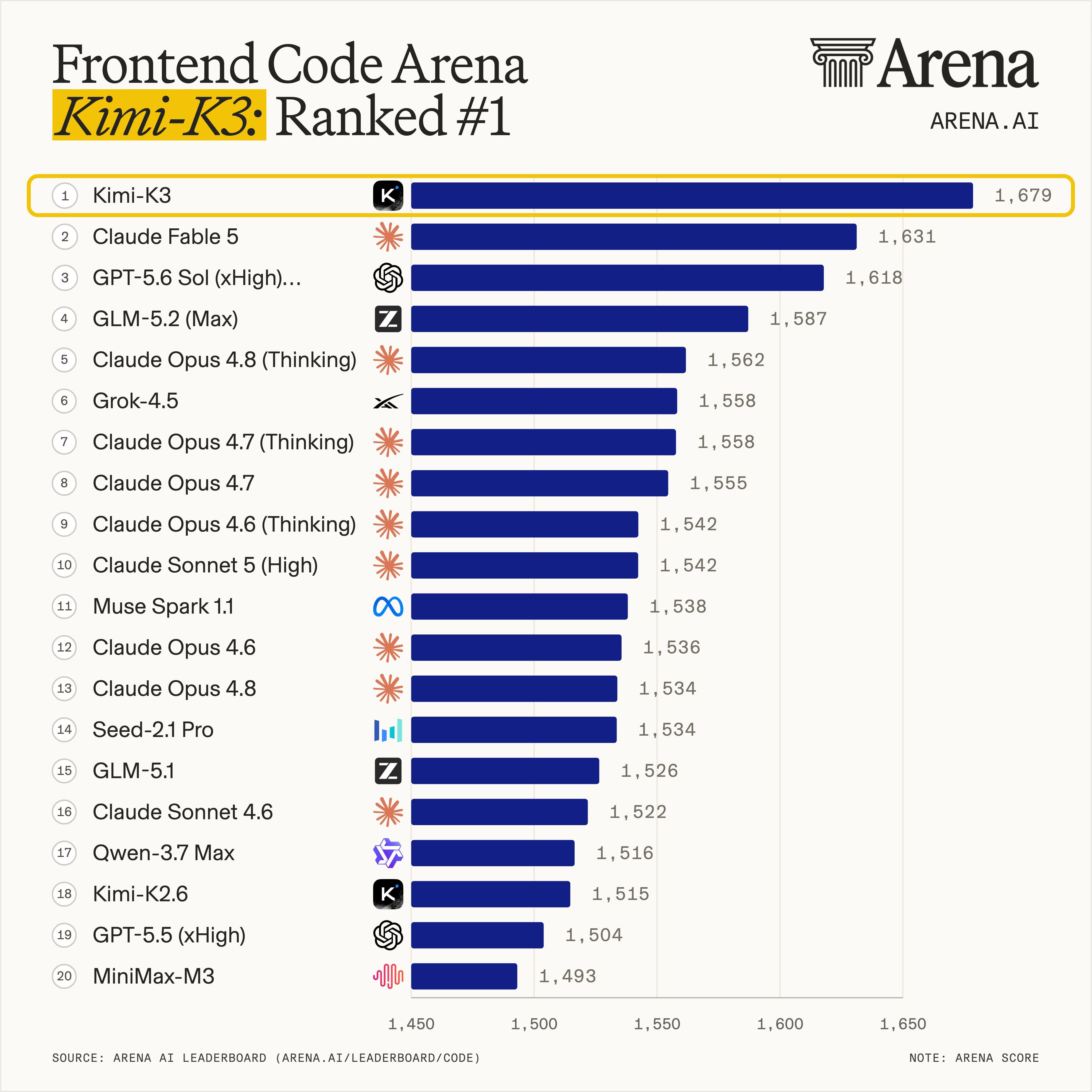
[2] Chart of the week: For the first time, a chinese open source model Kimi-K3 (from Moonshot AI) has taken the top position on the Frontend Code Arena & scoring similar levels to frontier on other benchmarks. USA is busy with banning data centres (recently in NY), new state regulations and pre approving frontier models - whilst Chinese open source surges on unencumbered at a different token price point. For any board weighing AI vendor lock-in, the leverage is shifting to the buyer — near-frontier capability you can host, fine-tune and run privately is now a credible negotiating position.
[3] Demis Hassabis just published the most consequential essay in AI this year.
The CEO of Google Deepmind & Nobel Prize winner proposes a FINRA style standards body for frontier AI. He estimates AGI in a few years - 10x the industrial revolution at 10x the speed. “We’ve essentially found a way to make sand think.”
Coincidently, In the same week 200 economists warn AI could outpace the industrial revolution - signed by 16 Nobel Laureates plus current Anthropic, OpenAi and Google executives. A call to action as they fear policy is unable to keep pace.
[4] 97% of firms run AI in production, 5% say their data can support it.
Enterprise AI isn't failing because models aren't powerful enough. It's failing because enterprises are trying to deploy AI solutions on top of fragmented data, disconnected systems and inconsistent governance. The gap between pilot and production is about architecture, not model capability. Read more at Forbes
[5] The chatbot is already old news - the fight has moved to ear, sight & lapel? TechCrunch, 10 July 2026
OpenAI hired Apple’s hardware chief to build the next interface. Apple just tried to freeze him out of it. The chatbot is already old news as a battleground — the real fight has moved to ear (Wispr Flow’s voice-first typing, OpenAI’s rumoured wake-word-free speaker), eye (smart glasses from OpenAI, Apple’s N50, Meta, Google) and lapel (AI pins/pendants both OpenAI and Apple are separately building). Apple’s suit doesn’t name Jony Ive, but it targets the two ex-Apple hardware leads — Tang Tan and Chang Liu — who’d know precisely which of those three form factors Apple was racing toward.
## 📚 THE LIBRARY· AI academy for board directors.
Stop Counting Pilots: What Should Actually Be on Your Board’s AI Dashboard
The problem.
Many board packs claiming to cover “AI progress” are activity reports: licences issued, workshops run, pilots launched
None of that tells a board whether the business is safer, cheaper to run, or harder to attack
82% of directors are already using AI; just 6% of boards have a policy (Diligent Institute) — and the same capability gap runs one layer down, through the workforce
The fix — one page, eight baskets:
Financial impact and strategic outcomes: revenue uplift, cost-to-serve, retention, speed to market — AI as capital allocation, not experiment
Workflow economics and adoption & trust: a “redesigned” workflow showing no cycle-time or cost movement has been decorated, not redesigned. Licensed-but-unused AI is shelfware with a subscription fee
Technical reliability and strategic control: the two baskets a risk committee should own outright — vendor concentration, model dependence, use cases sitting outside the regulatory taxonomy
Capability & culture: the basket most dashboards skip. Track training, reskilling against redesigned roles, and the talent bench gap versus AI-native peers
Portfolio discipline: pilots killed, and the line that matters more — benefits realised versus promised. 61% realised means over a third of board-approved value hasn’t shown up
The verdict: killed pilots tell you management is disciplined. Benefits realised tells you whether the portfolio works. Put the verdict first.
Plus: how to reweight the baskets by sector, why an all-green dashboard is one nobody has stress-tested, and why a blank cell is data too.
→ Read the full Library piece here
## 🛠 MONDAY MORNING
Week 2 of 6: “The Director’s AI Build”. Six weeks, one Monday Morning at a time — read, watch, listen, and one thing to actually build, 30 minutes a week.
You leave with a working setup, not a certificate: a scheduled public-information briefing, a saved skill, and a vibe-coded tool you built yourself — plus sharper questions for your own board’s AI oversight.
Every other director AI course teaches strategy from the outside. This one puts the tools in your hands. Read the full six-week programme
Week 2: Prompting & Context: the discipline behind good outputs
Why this week: The gap between a mediocre AI answer and a genuinely useful one is almost never the model — it’s what you told it. This is the highest-leverage skill in the whole series.
📖 **READ:** Anthropic — “Effective context engineering for AI agents”. The shift from “prompt engineering” to feeding the model the smallest, highest-signal context — written for practitioners, readable by anyone.
🎧 **LISTEN:** “Big Ideas 2026: The Agentic Interface”. Why the interface is moving from “typing a prompt” to “giving an outcome” — the idea that makes Weeks 3–4 make sense.
🛠**Build** Anthropic’s free Interactive Prompt Engineering Tutorial — a ~45-minute self-marking walkthrough. Skip the code chapters; the technique chapters apply directly to board work.
🛠**Build** (30 minutes)
Create a standing “board-level thinking partner” system prompt — save it as a Claude Project so it’s there every time, not retyped. This project is for questions and public research, never for real company documents.
Try this prompt (paste as your Project’s custom instructions):
“You are my board-level thinking partner. I sit on boards across [sectors]. When I ask about a strategic, risk or governance question: (1) give me the strongest counter-argument first, (2) flag what a board typically misses on this kind of question, (3) end with one question I could raise at the table. Base your answers only on general knowledge and publicly available information. I will never paste confidential company documents into this chat — if I ever do by mistake, stop and flag it rather than answering.”
[Go deeper: DeepLearning.AI — Generative AI for Everyone. Builds directly on prompting technique; still zero-code.]
That’s it for this week.
Next week: [1] ## 🎯 THE FRAME : Skynet didn’t have a board. Your company does.The scientists who built AI are scared. The regulators are catching up. The question for boards isn’t whether to govern AI — it’s whether you’re doing it for the right reasons.
[2] ## 🛠 MONDAY MORNING Week 3: Agents, loops & setting up Claude cowork.
Please feel free to send me any comments, feedback or suggestions to hello@thedirectorsbrief.com.
To help me extend the community, feel free to share this with a fellow board director who might find it interesting. Much appreciated.
Disclaimer: These are my personal views, shaped in a fast-moving environment and open to revision. They should not be taken as representing the perspectives of any boards or advisory roles, past or present.