


The Director Brief: AI intelligence for Board Directors
Strategy, Risk, Governance, Capability
Free Every Thursday. Issue #0002. 9nd July 2026
Only 39% of Fortune 100 boards have any form of AI oversight — a committee, a named director, an ethics function. Just 6% get management reporting that goes beyond adjectives. Uber just burnt through its entire 2026 AI coding budget in four months, capping token usage only after the fact.
This week’s issue: Ten ways AI can blow up your business……and what to do about it.
## 🎯The Frame · Ten ways AI blows up a business that never failed a single test — because most detonations don’t need the model to fail, only the governance around it to stand still while the risk moves at machine speed.
## ❓ Five for the Chair · This week’s key questions. The questions that tell you, in the next sixty minutes, whether your board is match fit to govern this.
## 📚The Library · The system. Shows you the fix. One loop, simple metrics to monitor, iterate continuously. Most boards fall at the second steps & don’t have real have visibility. This is not enough.
Also in this week’s issue:
## 📡 The Signal · AI signal vs noise. What changed this week. So what for the Board?
## 🛠 Monday Morning· The Director’s AI Build. Week one of a six week course for Board Directors. Free Director AI education programme….which puts the tools in your hands.
Read before your next board pack. Ai intelligence for directors - strategy, risk, governance, capability
👉 Read this week’s issue on TheDirectorBrief → · Subscribe free.
________________________________________________________________________
## 🎯 THE FRAME· the strategic conversation of the week
### Your board was built for risks that hold still. AI doesn’t.
Forty minutes on the agenda. A theoretical Executive or Board meeting - the CIO runs the accuracy charts. The General Counsel updates on the EU AI Act. The policy document gets signed off without a question. Polished papers, all minuted. Nobody asks whether the model on the slide is still the model in production — because by the time the papers were printed, the vendor had already pushed three updates, changed the token pricing twice, and quietly wired a new API into your customer data.
That is not a hypothetical. That is probably the average risk committee, this quarter, on AI.
The governance is theatre, and the reason is structural, not personal. AI risk breaks the three assumptions every board process was built on. It is probabilistic — right most of the time, wrong with total confidence some of the time; “show me the test results” gets you a confidence interval, not a certainty, and most directors have never governed one. It doesn’t sit still — a compliant system in January can be non-compliant by June without anyone touching the code, and it doesn’t stay where you put it either: AI is now inside spreadsheets, copilots, supplier portals and browser extensions, most of it uninventoried. And it moves at machine speed — use cases deploy in weeks, board cycles run in quarters, assurance runs in years. A biased model can serve a million decisions before the risk committee next convenes.
The numbers say the same thing from a different angle. Only 39% of Fortune 100 boards have any form of AI oversight at all — a committee, a named director, an ethics function. Just 6% get management reporting that goes beyond adjectives. That is not a knowledge gap. It is a governance gap, and it is compounding while you read this.
It compounds in ways that don’t need the model to be wrong. Anthropic’s Claude rebuilt elements of Figma’s product this year; Figma’s share price is down roughly 50% year to date — the model worked exactly as designed, for someone else’s benefit. Uber burnt through its entire 2026 AI coding budget in four months and only capped token usage after the fact. One governance vendor puts “shadow AI” — the tools staff use that IT never approved — at 60–70% of what’s actually deployed inside the average regulated firm. None of that required a failure. It required a board that checks in quarterly governing a system that changes daily.
This week’s Frame sets out the ten specific ways that mismatch detonates — strategy, decisions, data, cyber, regulation, operations, reputation, talent, concentration, economics — and the uncomfortable finding underneath all ten: half of them happen when the AI works exactly as designed. Wrong data, wrong speed, wrong owner, wrong price. Not a wrong answer. Read the full article here.
## ❓ FIVE FOR THE CHAIR
The five questions that tell you, in the next sixty minutes, whether your board is matchfit to govern this.
1. Where in this business would AI failure be unrecoverable — and where could a competitor use AI to reprice our industry before our next strategy cycle?
2. Could management show us, within 48 hours, which of our data is feeding which models — including the public tools our people are using without telling us?
3. If our most important AI vendor deprecated its model or went down for a week, what is the impact to the business — and when did we last test that answer?
4. Which decisions have we allowed AI to take autonomously, who is the named owner of each, and did this board ever explicitly make that call?
5. What is our total committed AI spend, what measurable return has it generated, and what are the stop/go criteria for the pilots we are funding?
## 📡 SIGNAL· AI signal vs noise
[1] Stat of the week: 97% of enterprises have deployed AI agents. 12% got to production scale. Only 14.4% got full security or IT approval before shipping.
Composio’s AI Agent Report is the empirical basis for Bank of England Deputy Governor Sarah Breeden’s June warning that existing oversight frameworks were not designed for autonomous agents. 97% executive deployment, 12% at-scale success, 14.4% pre-production security sign-off. The gap between ‘deployed’ and ‘governed’ has become the board question of the quarter. How many agents have passed the posture rules set by the board?
[2] Chart of the week: Representative standard AI output-token prices for selected models, $ per 1m output tokens.
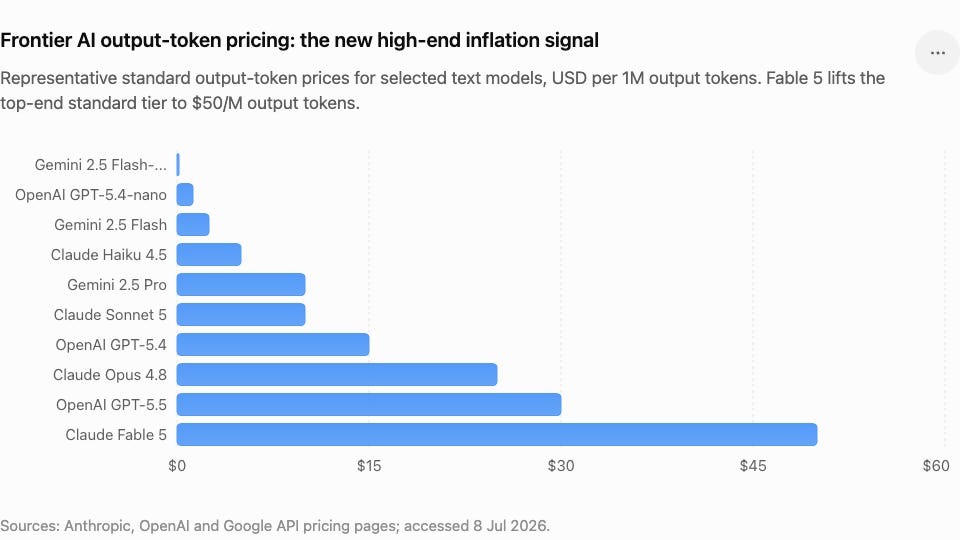
Fable 5 lifts the top-end standard tier to $50/m output tokens (vs $25 for Opus 4.8 ie a 2x change). AI token pricing is deflating at the bottom - but inflating at the strategic frontier.
AI unit economics now matters as much as model capacity. The same workflow can swing sharply in cost depending on model routing & agent design. Boards should demand cost per workflow, cost per decision and cost per customer retention. Agentic AI needs guardrails, budgets & kill rules - not just pilots.
[3] Is this how AI profits get taxed? Altman floated a 5% US government stake across the top AI labs. CNBC
Framed as an Alaska-style public wealth fund distributing AI’s economic upside; discussions are early and would likely need Congressional action. Watch for this reframing of the “AI regulation vs innovation” debate into an equity/ownership question — a live wildcard for how AI profits get taxed or shared. Move over token & robot tax, is this a new component to fund ‘universal income’ as loved by the billionaire tech bros? Or is this the start of something more sinister.
[4] Is this the start of a market correction - admission of excess supply and demand becoming price sensitive? Bloomberg
Whilst enterprises are looking for ROI, becoming sensitive to token costs - in the case of Uber instituting a monthly cap across its engineering team (after it burned its full year token budget in 4 months). Bloomberg reports Meta is building "Meta Compute," a cloud arm to rent out excess AI capacity and host models — stock popped 9% on the news. Meta has no enterprise AI business today; this is a bet that it's over-built (compute) and needs a release valve. This mirrors Elon Musk selling excess compute as part of the space X IPO (ie Grok doesn’t need it because it doesn’t have the demand). Coupled with the hyperscaler committing $600-700bn in capex in 2026, locking in commitments of $1.5T over the next 2-3 years - increasingly being funded by debt (Google recently announced issuing bonds, alongside space X debt issue). Capex/revenue mismatch, utilisation collapse (5% average GPU utilisation - according to Cast AIs 2026 Kubernates report. However the power constraints and pre-committed capacity suggest an unwind may be delayed to 2027-28?
[5] Cloudflare wants to put a paywall on the agent internet, could this redirect billions in online revenue?
On 1 July, Cloudflare — which sits in front of ~20% of the internet — announced it will block AI training bots and agent crawlers by default on ad-supported pages across its network from 15 September 2026, unless a site owner explicitly opts them back in. Cloudflare simultaneously launched Pay-Per-Crawl and Pay-Per-Use marketplaces, so publishers can charge AI companies for content access or downstream use.
→ Source: Your site, your rules: new AI traffic options for all customers — Cloudflare blog — https://blog.cloudflare.com/content-independence-day-ai-options/ · 1 Jul 2026 [4m+ views to date!]
## 📚 THE LIBRARY· AI academy for board directors.
The governance fix. Not a tenth committee. One loop, clear metrics
………Most boards have stalled on step two
Ten risks. One fix, run continuously — because governance built to hold still cannot manage a risk that refuses to. Many boards clear the first two steps without much resistance: agree a posture, build the inventory. Then they stall, because the next three — naming an owner, hard-wiring the controls, closing the loop with meaningful metrics — are the ones that turn a policy document into personal accountability. That’s not an accident. It’s easier to write a posture statement than to put your name against a live AI system, and easier to build a register than to test whether anyone actually acts on it.
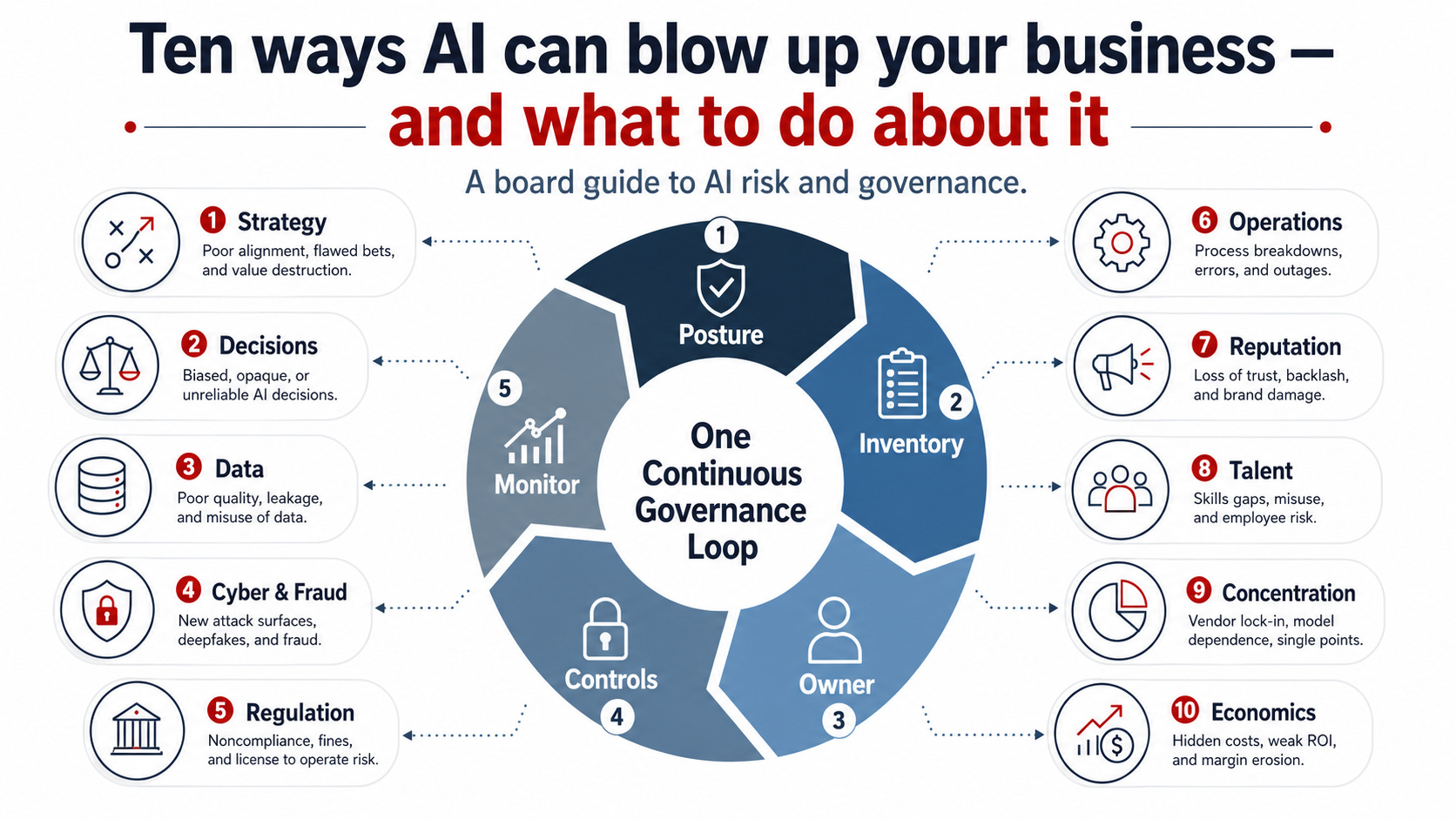
A board should not accept a dashboard that says: “we have 150 AI use cases.” That is usually a symptom of weak strategy. The better answer is: “we have 8 scaled AI workflows, 4 material strategic bets, 3 stopped initiatives, £X realised value, Y% provider concentration, Z unresolved risks.”
→ Read the full Library piece — “The governance fix: one loop, clear metrics”
## 🛠 MONDAY MORNING
Starting today: “The Director’s AI Build”. Six weeks, one Monday Morning at a time — read, watch, listen, and one thing to actually build, 30 minutes a week.
You leave with a working setup, not a certificate: a scheduled public-information briefing, a saved skill, and a vibe-coded tool you built yourself — plus sharper questions for your own board’s AI oversight.
Every other director AI course teaches strategy from the outside. This one puts the tools in your hands. Read the full six-week programme
Week 1 - AI in plain English: What an LLM, Agent & and a prompt actually are
Every later week assumes you know what these words mean. Twenty minutes now saves confusion for six weeks.
📖 **READ:** McKinsey — “The AI reckoning: how boards can evolve”. The posture-and-archetypes framing every board conversation eventually reaches for.
🎥 **WATCH:** Stanford GSB — “Co-Intelligence: An AI Masterclass with Ethan Mollick”. Wharton’s Mollick on how AI actually changes work — the clearest non-technical primer available.
🎧 **LISTEN:** Knowledge at Wharton — “AI in 2026: What’s Next?”. 20 minutes, board-relevant framing, no jargon.
🛠**Build** (30 minutes): Open Claude (or ChatGPT). Write your first structured prompt — role, context, task, format. No documents involved — just a topic. Most directors have never done this deliberately.
Try this prompt: “You are a sharp, sceptical non-executive director joining a board that is about to discuss [a topic — e.g. ‘entering a new international market’ or ‘a major AI vendor contract’]. Without any specific company information, give me: (1) the three toughest generic questions a NED should ask about a move like this, (2) one assumption management teams typically get wrong, (3) one blind spot boards commonly miss. Keep your answer to under 150 words.”
[ Go deeper: DeepLearning.AI — AI For Everyone (Andrew Ng). Free, ~4 weeks self-paced, zero jargon, built for non-technical leaders.]
That’s it for this week.
Next week: [1] ## 🎯 THE FRAME AI strategy best practice…..so you don’t need to pay the consultants to borrow your watch & tell you the time?
[2] ## 🛠 MONDAY MORNING Week 2: Prompting and context engineering. A saved “thinking partner” system prompt. A standing Claude Project with a built-in confidentiality guardrail
Please feel free to send me any comments, feedback or suggestions to hello@thedirectorsbrief.com.
To help me extend the community, feel free to share this with a fellow board director who might find it interesting. Much appreciated.