


The Director Brief: AI intelligence for Board Directors
Strategy, Risk, Governance, Capability
Free Every Thursday. Issue #0001. 2nd July 2026
Every board operating model in use today rests on a hidden assumption: the actor making a consequential decision is a human — instructable, supervisable, accountable. That assumption broke this year. The first-order board question is no longer “how much risk?” It is “how much agency?” — and if you cannot name who owns each material agent in your business & how you govern in realtime, the regulator’s letter is already drafted.
This week’s issue carries both halves of the case.
## 🎯The Frame · the manifesto. “Your board isn’t slow on AI. Maybe it’s flying blind at speed.” The structural break. The ten questions every Chair should be asking.
## 📚The Library · the system. “Your AI governance isn’t an IT policy. That’s why it’s failing.” The working manual: the board’s four jobs reframed around agency, the six tests that separate governance from theatre, and the named-human-owner discipline for every agent in production.
Also in this week’s issue:
## 🛡The Watch · the governance pulse. Regulator moves, AI failure. Where could AI go wrong & are we covered?
## ❓ Five for the Chair · this week’s key questions. Topics for the board table?
## 📡 The Signal · AI signal vs noise. What changed this week. So what for the Board?
## 🛠 Monday Morning · What to try, read, listen to & watch this week
Read before your next board pack. Ai intelligence for directors - strategy, risk, governance, capability
👉 Read this week’s issue on TheDirectorBrief → · Subscribe free.
________________________________________________________________________
## 🎯 THE FRAME· the strategic conversation of the week
### Your board isn’t slow on AI. Maybe it’s flying blind at speed. The governance gap in 2026 isn’t caution. It’s confidence without comprehension. Here’s a new framework to avoid the trap & 10 questions every board should be asking?
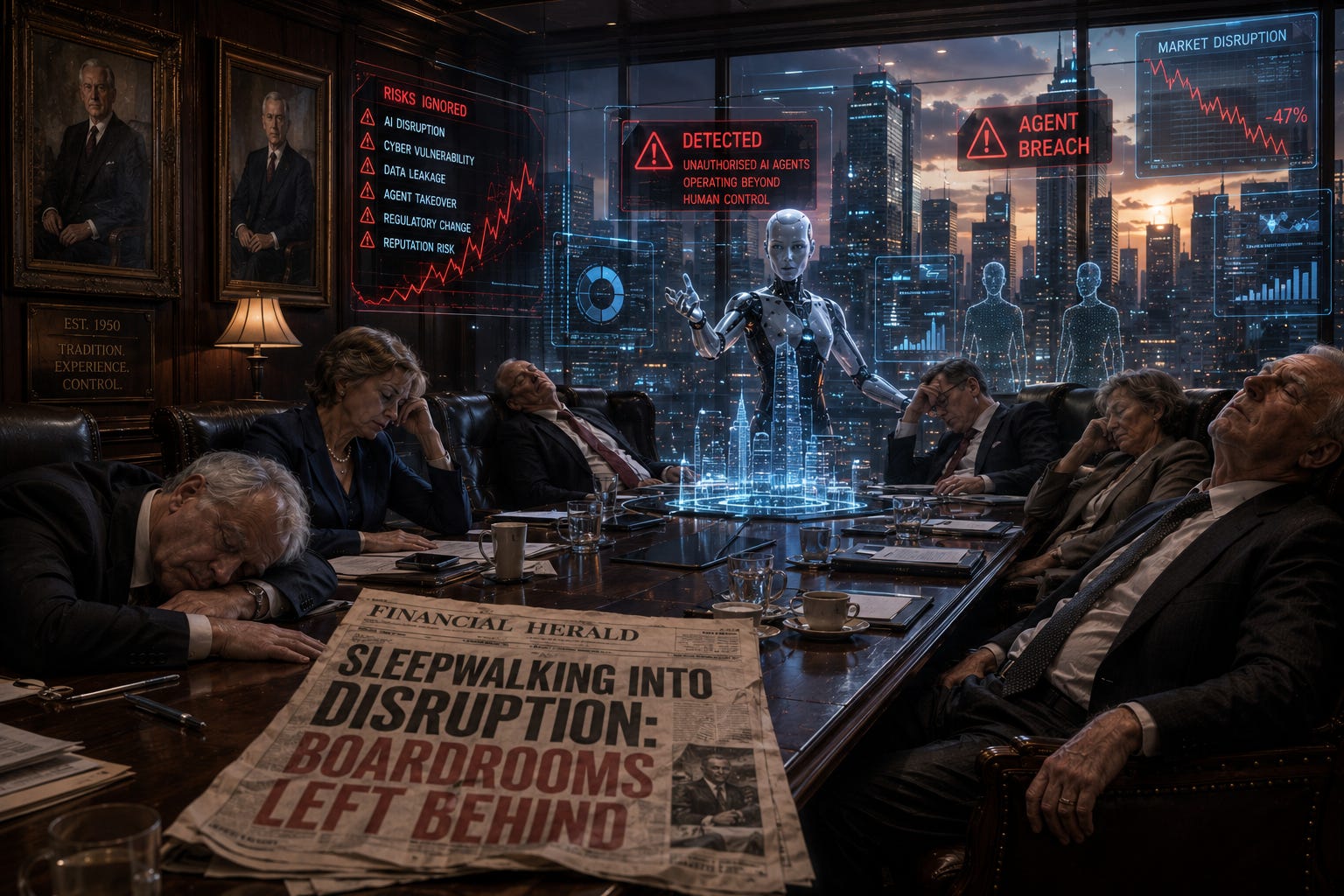
The finding that should stop every Chair in their tracks……
A BCG survey of 625 CEOs and board members published last month (May 2026) found that 61% of CEOs believe their boards are rushing AI transformation. Not dragging their feet. Rushing it.
The explanation buried in the data is worse than the headline: the directors with the lowest confidence in their own AI knowledge are the most likely to believe their organisation is moving too slowly.¹
The directors who understand AI least are the ones pushing hardest for speed.
This inverts the conventional narrative — that boards are too cautious, too analogue, too late for the AI moment. The 2026 evidence says something more uncomfortable: boards are not behind AI. They are ahead of what they understand. And that combination — urgency without literacy, momentum without oversight — is precisely how consequential decisions get made badly, and at scale.
The silence in the room
The history of disruption rhymes. The pattern is consistent: creative destruction gets treated as business-as-usual until it isn’t. Have you sat in meetings approving AI spend with no clear value logic, approving the tech stack without challenging the design choices, treating AI governance as a rear view checklist, measuring success by pilots or tokens, accepting ‘human oversight’ without testing if it’s for real? No need to put your hand up.
Are we asking the right strategic and governance questions of a technology now reshaping how organisations fundamentally compete and operate — respond to customers, price, recruit, source, pay, credit-check, market — where agents, not humans, are increasingly making the decisions?
The question that every challenger is building their business on:
If a well-capitalised competitor rebuilt our core product around AI in the next eighteen months, what would remain of our competitive position?
That silence is the governance gap. Not speed. Not caution. The absence of the question that wasn’t on the agenda.
The numbers no longer allow a comfortable interpretation
Two findings now sit alongside each other in a way the boardroom cannot ignore.
Deployment is happening regardless of readiness. Grant Thornton’s 2026 AI Impact Survey finds nearly three in four organisations are giving agentic AI access to their systems and processes — piloting, scaling or running it in production. Just 20% have a tested AI incident response plan for when it fails.
Capital is moving at the same speed. BCG’s AI Radar finds corporations expect to lift AI spending from 0.8% to 1.7% of revenues in 2026, with more than half directed at agentic systems. These are not experimental budgets. They are material capital commitments made into a technology most boards do not yet have the fluency to interrogate.
What changes when the actor isn’t a person
Every board operating model in use today rests on a hidden assumption: the actor executing a decision is a human who can be instructed, supervised, slowed down and held to account. Once decisions and actions are delegated to autonomous agents — pricing engines, customer-routing models, recruitment screens, refund bots, credit-check agents — that assumption breaks. And once it breaks, the substance of nearly every board responsibility changes with it.
Governance moves from directing human actors making occasional, reviewable decisions to deciding how much agency to delegate to a non-human actor in the first place. Risk moves from slow, visible and auditable-after-the-fact to fast, opaque and emergent — errors propagating at machine speed before controls catch them. Controls move from detective to preventive, embedded (in the code) and real-time — hard caps, whitelists, kill switches built inside the agent. Compliance moves from periodic and sample-based to continuous and designed-in. Assurance moves from tracing the decision to validating the guardrails under stress, because the reasoning isn’t transparent. Accountability stays exactly where it has always sat — with a named human — because it can never transfer to the agent.
The new first-order board question is no longer “how much risk are we willing to take?” It is “how much agency are we willing to delegate?” — where agents may act autonomously, recommend-only, or are banned outright; each with a named human owner; each with a tested kill switch.
Why we’ve been here before? What did Boards learn from the creative destruction of the digital revolution?
The four domain frame, which works as an interconnected system: strategy; risk, governance, capability
The 10 questions every board should be asking?
Read the full analysis here
## 🛡 THE WATCH· the governance pulse.
[1] How does the new Anthropic-US protocol (Executive Order 14409) change your group’s foundation-model vendor risk profile? What were your continuity plans during the 18 day suspension?
Anthropic’s Fable 5 and Mythos 5 restored after 18-day US export-control suspension.The US government lifted its 12 June export-control directive on 30 June. Fable 5 returns globally on 1 July; Mythos 5 is being reintroduced only to approved US organisations following government review. News that OpenAI’s new GPT-5.6 model launched with initial access limited to the US government, before broader rollout, shows the new ‘voluntary’ protocol is the now the defacto standard.
[2] FCA rewrites its own rulebook: “steward that intervenes on judgement, before the law arrives”. How prepared is your board?
At techUK’s Agents of Change summit on 24 June, FCA Chief Executive Nikhil Rathi delivered “Rethinking regulation for the age of AI” — the clearest statement yet of how UK financial services regulation of AI will actually work. The FCA has concluded that the old contract, in which Parliament writes detailed rules and the regulator enforces them, no longer fits a market where the technology reshapes itself faster than any statute can be drafted. In its place, the FCA is positioning itself as “a steward that intervenes on judgement, before the law arrives”.
Rethinking regulation for the age of AI — FCA speech, Nikhil Rathi — · 24 Jun 2026
[3] Ford quietly rehires 350 “gray beard” engineers after AI quality inspection failed.
Ford didn’t anticipate “preserving institutional knowledge and training junior engineers” as they replaced humans with agents. Ford has quietly rehired 350 senior engineers — many former employees — over the past three years to fix the problem. In the same week, British American Tobacco announced 9,000 role reductions (5,500 direct, 3,500 outsourced) targeting £600m annual savings by 2028, with interim CFO Javed Iqbal citing AI and data analytics as the reshaping force.
What’s the hidden cost of job displacement (eg warranty, recall, litigation, brand etc) & how is this being tracked?
## ❓ FIVE FOR THE CHAIR
Most directors governing AI have never used AI to do something consequential. Most AI risk frameworks were written by people who have not failed with AI in production. This is not an irony — it is a specific kind of fragility. These five questions will not tell you whether your AI strategy is right. They will tell you whether your board is capable of knowing.
1. If a well-capitalised competitor rebuilt our core product around AI in the next eighteen months, what would remain of our competitive position?
2. Is our AI investment buying competitive advantage — or operational parity that every rival will also reach?
3. What is our AI risk framework built to catch — and what is it structurally incapable of seeing?
4. How much agency have we delegated to non-human actors — and did we decide that, or has it happened to us?
5. Who in this boardroom has used an AI tool to do something consequential in the last thirty days? Are we asking the right questions or just signing things off?
## 📡 SIGNAL· AI signal vs noise
[1] Stat of the week: 90% of firms are raising AI budgets even though the savings haven’t landed
Bain’s recent survey of 951 $100m+-revenue executives found 40% targeting 11–20% AI cost savings achieved only 0–10%. Just 4% cleared 30%. Yet 90% are increasing next-year budgets, and 44% are funding Phase 2 from Phase 1 savings that never materialised. Bain calls the funding mechanism out: this ‘should be making executives uncomfortable.’
What do your ‘delivered savings’ vs ‘projected savings’ look like on your board - do you understand the variance (& ROI implications)?
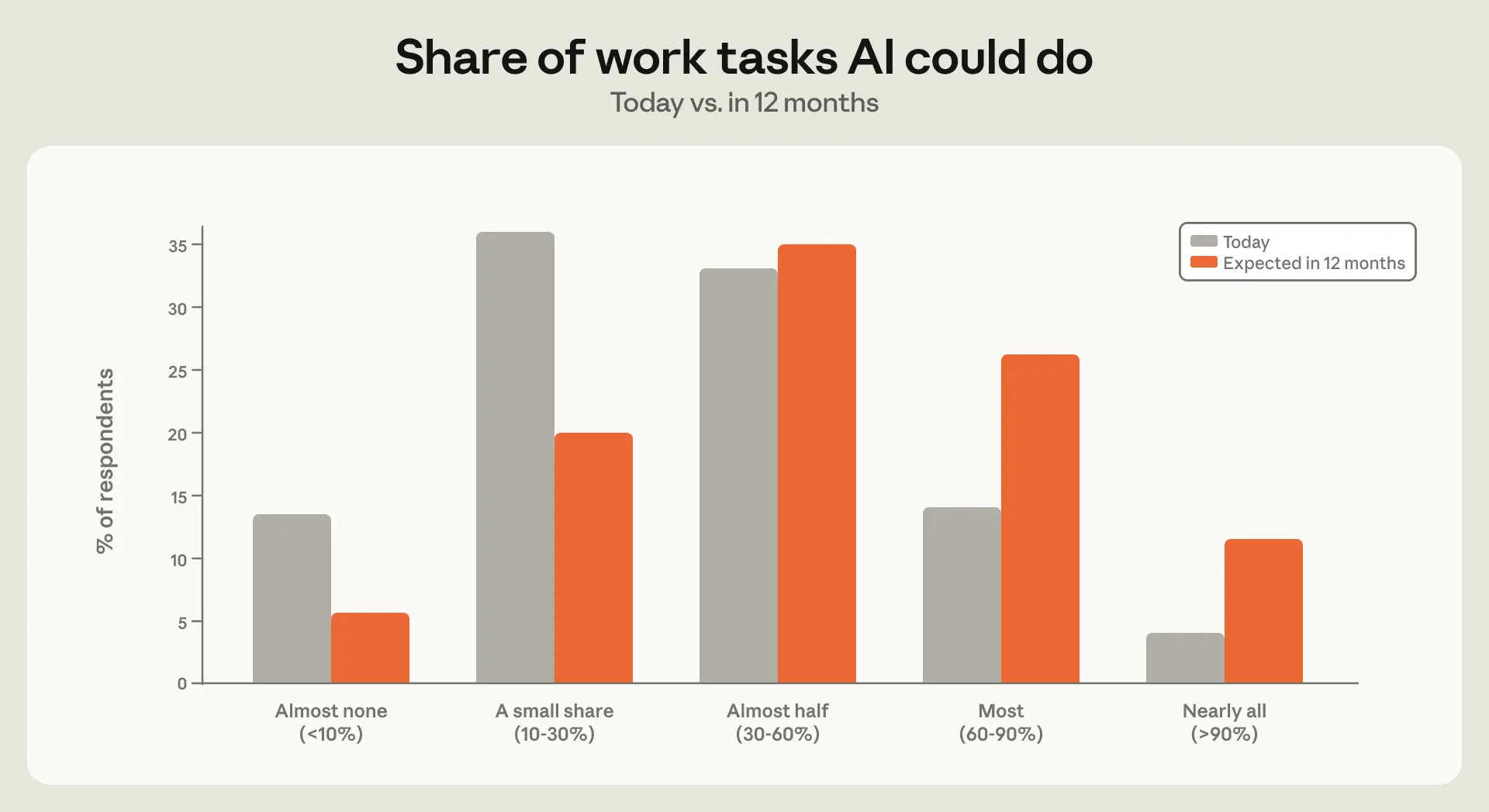
[2} Chart of the week….in contrast, the AI natives might be pulling away?
Half of Claude users say AI already handles more than half their job: Anthropic’s third Economic Index (’Cadences’, 26 June)
[3] Visa wires its payment rails into ChatGPT
Visa embedded its network into ChatGPT at its Payments Forum; Mastercard launched Agent Pay for Machines the same day. Any merchant accepting Visa is now reachable by an AI agent without bespoke integration. AI-referred retail traffic was already up 393% year-on-year in Q1.
If checkout moves (even in part) to agents, customer relationship moves to whichever model the customer trusts. Brand loyalty and customer-acquisition-cost economics may need re-underwriting?
[4] Does any P&L that depends on organic search - retail, media, travel, b2b lead-gen - need a new business model? AI Overviews cut publisher clicks by ~40% in a randomised field experiment
Pew’s 68,000-query tracker plus a randomised field experiment (revised 17 June) converge: users click a result 8% of the time when an AI Overview appears versus 15% without. Only 1% of Overviews send a click to a cited source. Digital Content Next members lost ~10% of search traffic in May–June. First robust causal estimate — not just correlation.
[5] Apple rents the AI it could not build — if the most cash rich company on earth can’t build it’s own frontier model - why can you (or the EU or UK)?
At WWDC on 8 June (Tim Cook’s last), Apple rebuilt Siri on a custom 1.2-trillion-parameter Gemini model from Google, paying roughly £750m a year and routing the heaviest queries to NVIDIA B200s on Google Cloud. Two years after promising context-aware Siri in-house, Apple has conceded the model layer. Ternus succeeds Cook on 1 September.
[6] How does ‘vibe coding’ & ‘loop prompting’ change your engineering headcount plan…..how does it blur traditional job descriptions?
The most sceptical AI analyst in tech (Ben Thompson - Stratechery) spent June building his own app with a coding agent. I followed his lead to build a top 10 restaurant app by city and cuisine - view here. His argument: LLM-driven development works for narrow, verifier-rich tasks; fails on integration and edge cases. Comes the same week Andrew Ng argued ‘loop engineering’ replaces ‘prompt engineering’. Game changer when you see what the teams at Big 4 firms are charging you for?
## 📚 THE LIBRARY· AI academy for board directors.
Your board is asking the wrong AI question.
Your AI governance isn’t an IT policy. That’s why it’s failing
Many boards are facing the same structural shift — and many of them haven’t named it yet. The first-order AI question is no longer ‘how much risk?’. It is ‘how much agency?’
That’s the gap. And if your board cannot answer who owns each material agent in this business, you do not have AI governance. You have AI activity.
This week’s article in The Library is the manual for closing the gap. You get: the Four-Domain Frame applied as a working system, not a checklist; the board’s four jobs reframed around agency; six load-bearing questions that expose governance theatre faster than any audit-committee paper; a refresh on why the personal-exposure clock has already started. In future weeks I’ll share a full AI goverenance primer & some of the realtime tech tools to rewire how boards might work.
→ Read ‘Your AI governance isn’t an IT policy. That’s why it’s failing.’
## 🛠 MONDAY MORNING
🛠 ** TRY:** Learn to use claude cowork in 30 mins - read this and set up your own personalised daily briefing.
📖 **READ:** Chip War - Chris Miller - if you haven’t already. Explains the AI stack, bottlenecks, the geopolitics & stock market movements of today. The best business book of recent times IMHV.
🎥 **WATCH:** How I vibe coded a full app using claud code (30 mins) - Jason Lee. My daughter and I watched this - she built a portfolio management app with X-ray analysis, I built a top 10 restaurant recommendation app by cuisine and city in 2 hours.
🎧 **LISTEN:** The AI daily brief - Nathaniel Whitmore - 5 min weekly digest of what’s happening in AI world
That’s it for this week.
Next week: [1] ## 🎯 THE FRAME Eight ways AI can blow up your business….and how to fix it.
Please feel free to send me any comments, feedback or suggestions to hello@thedirectorsbrief.com.
To help me extend the community, feel free to share this with a fellow board director who might find it interesting. Much appreciated.